
Your cart is empty
Discover them:
The "microbiome-friendly" movement is underway! And believe us: it's excellent news for your skin. Prebiotics, probiotics, and postbiotics are its leading proponents, those that are beginning to become the common thread in our skincare formulas.
What does this change? Superior skin biocompatibility, resulting from a more precise understanding of the microcosm that organizes itself on the surface of our epidermis. Because our skin remains a barrier: the first, in fact, against pathogens and daily aggressions.
You can't go wrong with this: adding biotics to your routine is a wise decision for all skin types and ages. And for added consistency, don't forget the foundation of a healthy skin microbiome: a pH aligned with that of the skin's surface and a formula that avoids the madness of excessive preservatives. You'll see, it already makes a difference.
Biotics are a family of ingredients that includes probiotics, prebiotics, and postbiotics. Their main role is to strengthen the flora that inhabits the surface of our epidermis, now more commonly known as the "skin microbiota."
This microbiota plays a crucial role in the apparent health and beauty of our skin. Its imbalance is even implicated in certain conditions, such as acne, eczema, and dandruff. Conversely, several studies have already demonstrated the benefits of biotics in reducing wrinkles, redness, itching, and blemishes. Of course, it's important to keep in mind that this research focuses on very specific strains—which may not be the same ones used in your skincare products!
Our skin microbiota is incredibly rich and diverse. So much so that it's almost like a skin "fingerprint": no two are alike! Remember, then, that cosmetics enriched with pre-, pro-, and postbiotics primarily help maintain the essential bacterial balance of your skin. Its well-being and radiance depend on this homeostasis.
It's what ?
These are microorganisms in their own right, which we could call "good bacteria" for simplicity's sake. Although they are considered viable in your cream, it's important to know that the probiotics highlighted on the packaging are not, strictly speaking, live bacterial strains.
At least not in Europe: cosmetic regulations prohibit it for understandable health reasons. These are therefore dormant forms, subject to rigorous sterilization. Rest assured, they are still perfectly active for your skin. The two main categories of probiotics used in skincare are Lactobacillus and Bifidobacterium.
Additional information: probiotics can colonize your skin microbiota through topical application (via your cream or serum, for example), but also through ingestion (via your food or a dietary supplement).
Find it in…
In cream form: Aime's Barrier Cream , a moisturizing treatment formulated like a little cashmere for the skin to slip on every morning. It protects and strengthens the skin barrier, while improving the skin's resilience and firmness thanks to its biomimetic profile.
As a shower gel: the Saffron & Cedar shower gel from Salt & Stone. A skincare-infused formula with cutting-edge anti-aging actives such as probiotics, hyaluronic acid, niacinamide and vitamin C, with an aromatic fragrance with a soft wax scent.
As a dietary supplement: Microbiote & Peau by Atelier Nubio, a 100% probiotic formula based on four strains adapted to the needs of reactive and blemish-prone skin. Use as a 3-month course or continuously.
It's what ?
It's essentially the food for probiotics, their nutrients!
They can also be compared to fertilizer, but the accepted term is "substrate." The beneficial bacteria on your skin's surface feed on them to continue thriving and maintaining their place within your microbiota. They therefore selectively promote its development and, in doing so, strengthen your skin's first line of defense.
In topical cosmetics, sugars and sugar derivatives are the primary agents responsible for this prebiotic function. This is the case, among others, for sorbitol, inulin, and xylitol. But in reality, a great many ingredients can act as substrates!
More info: beware of the marketing ambiguity surrounding the commercial name "prebiotic." Since many substances can potentially act as prebiotics, inaccuracies abound. Some brands place squalane or even surfactants in this category…
Find it in…
In cream form: Absolution's Health Cream. It is formulated with BioEcolia®, a patented prebiotic, combined with hyssop extract (soothing), coconut oil (purifying), and honey (restructuring). It is particularly suitable for blemish-prone skin.
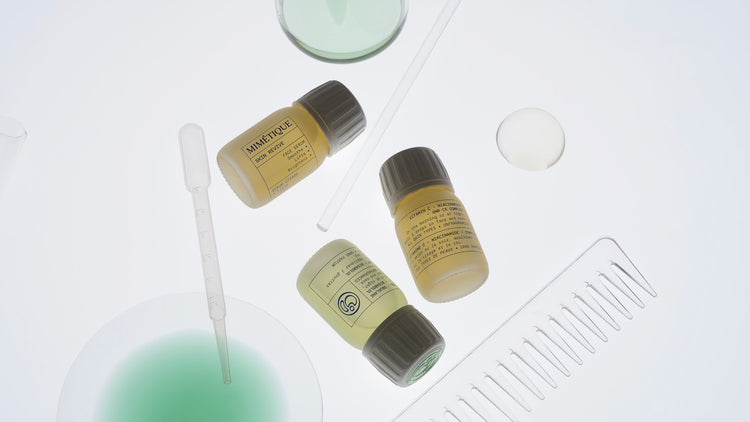
As a serum: Mimétique's SKIN REVIVE. It is boosted by the SMR-C5 complex, which notably includes oligosaccharides. These can act as prebiotics. Highly concentrated (30% active ingredients), this serum targets wrinkles and loss of radiance.
For a drink: Cherico's Natural Chicory. Yes indeed! Chicory is known to be very rich in inulin. It's even one of the richest sources identified to date. Enjoy it as a coffee substitute, with plant-based milk or cow's milk.
It's what ?
These are the waste products of probiotics. They are sometimes called "ghost probiotics" because they are cellular fragments of microorganisms, sometimes associated with their metabolites. If you've been following along, you'll see that the cycle is complete: probiotics consume prebiotics, which they then break down into postbiotics.
These inanimate ingredients act like good compost: they provide the microbiota with nutrients that support and regulate many skin mechanisms. Among them are organic acids such as lactic acid, peptides, enzymes, cytokines, and exopolysaccharides.
More info: Even less well-known than postbiotics are parabiotics. They actually belong to the postbiotic group as well. Since these terms are still relatively new, their definitions tend to overlap and sometimes overlap. More to come!
Find it in…
For makeup removal: Time to Detox by Demain Beauty. The cleansing and makeup removal step is one of the most delicate for your skin's flora because (by definition) it disrupts its bacterial balance. So, this enriched product is a big yes!
For blemish control: Demain Beauty's Balance Your Pores. Blemishes are sometimes associated with the proliferation of pathogenic microorganisms. This cream helps to reset the pores thanks to a postbiotic enriched with zinc, which has purifying effects.
For anti-aging care: Happy Age by Demain Beauty. A serum with an original two-phase texture, but above all, a formula boosted with pre, pro, and postbiotics that helps restore comfort and radiance. As a bonus, it contains a CBD-like active ingredient to prevent the appearance of expression lines.